
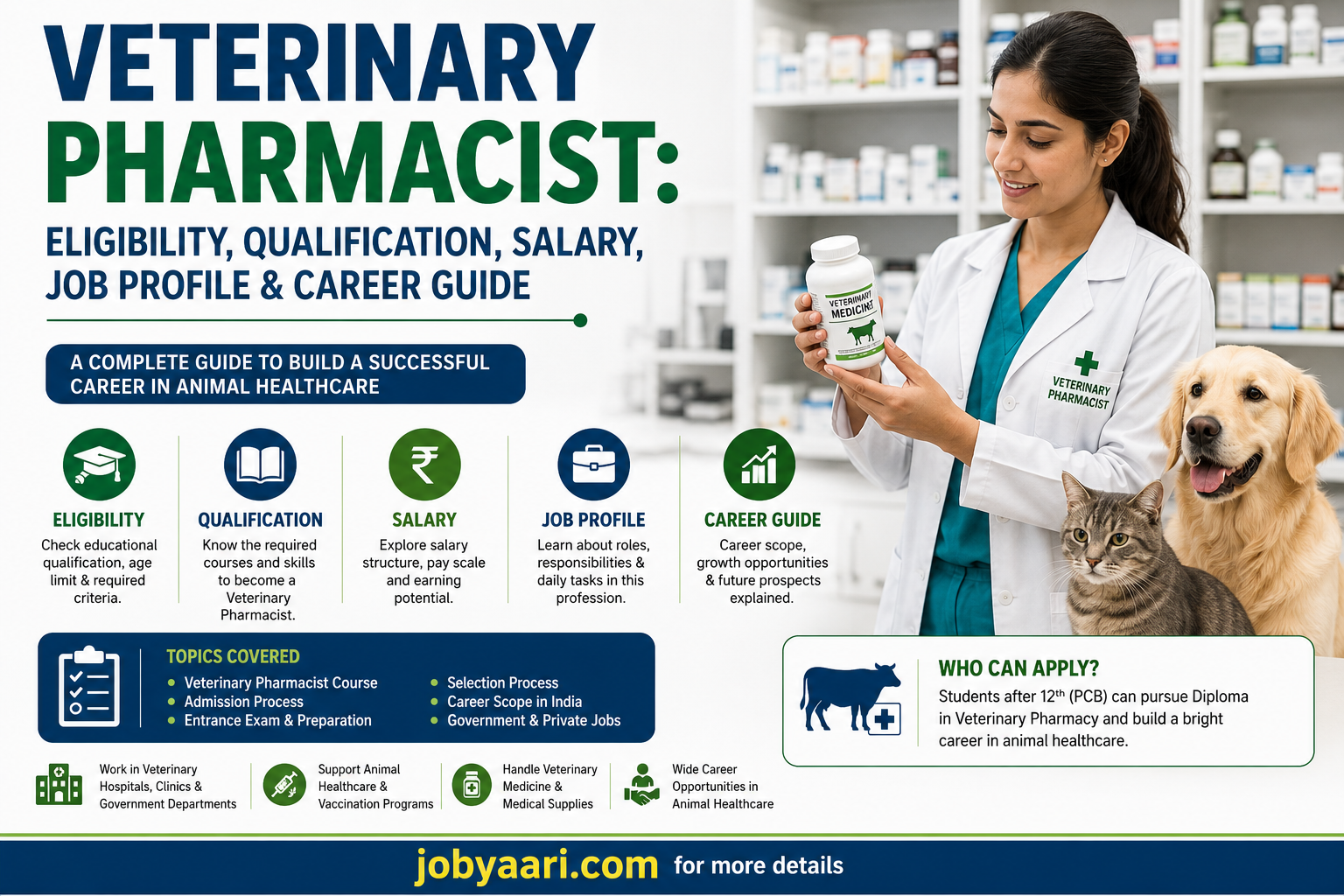
Veterinary Pharmacist: Eligibility, Qualification, Salary, Job Profile & Career Guide
Veterinary Pharmacist: Eligibility, Qualification, Salary, Job Profile, Exam & Career Guide
If you love animals and are interested in medicines, healthcare, and government jobs, a career as a Veterinary Pharmacist can be a promising option. Veterinary Pharmacists work in the animal healthcare sector and support veterinary doctors, animal hospitals, livestock centres and veterinary medicine services.
This career is different from becoming a Veterinary Doctor. A Veterinary Pharmacist generally follows a specialised pharmacy or para-veterinary education pathway and works within the responsibilities permitted by the applicable rules.

Jobyaari.com
What is a Veterinary Pharmacist
A Veterinary Pharmacist is a professional who works with medicines and healthcare products used for animals. Their responsibilities can include medicine management, maintaining drug stocks, supporting veterinary healthcare services and assisting veterinary professionals.
Veterinary pharmacy focuses on medicines for animals rather than human patients. The work can cover medicines used for pets, cattle, goats, poultry and other animals.
Typical responsibilities may include:
-
Managing veterinary medicines
-
Maintaining medicine stocks
-
Checking expiry dates
-
Storing medicines properly
-
Maintaining medicine records
-
Supporting vaccination and disease-control programmes
-
Assisting veterinary doctors as permitted by departmental rules
-
Educating animal owners about proper medicine use under authorised supervision
-
Supporting veterinary hospitals, dispensaries and field programmes
The exact duties depend on the employer, state service rules, and the candidate's qualification.
Veterinary Pharmacist: Quick Overview
Particular |
Details |
|---|---|
Career |
Veterinary Pharmacist |
Field |
Veterinary Healthcare & Animal Pharmacy |
Main Work |
Veterinary medicines and animal healthcare support |
Minimum Education |
Depends on state/institution |
Common Course |
Diploma in Veterinary Pharmacy in states/institutions offering the programme |
Entry Point |
Usually after Class 12 |
Workplaces |
Veterinary hospitals, dispensaries, animal healthcare companies and government departments |
Government Jobs |
Available when vacancies are notified by the concerned department/recruiting body |
Salary |
Depends on employer, pay level, location, and experience |
Career Scope |
Government veterinary services, private animal healthcare, veterinary pharma and livestock sector |
What Does a Veterinary Pharmacist Do
The job of a Veterinary Pharmacist is not simply about giving medicines to animals. It involves several responsibilities related to safe medicine handling and veterinary healthcare support.
1. Veterinary Medicine Management
A Veterinary Pharmacist may handle medicines used for the treatment and prevention of animal diseases.
Responsibilities can include:
-
Receiving medicines
-
Maintaining stock
-
Checking expiry dates
-
Proper storage
-
Maintaining inventory records
-
Issuing medicines according to authorised prescriptions or instructions
2. Supporting Veterinary Doctors
Veterinary Pharmacists may work alongside veterinary doctors and other animal healthcare professionals.
Depending on the workplace and rules, they can assist with:
-
Treatment-related activities
-
Medicine preparation
-
Vaccination programmes
-
Veterinary camps
-
Disease-control programmes
3. Maintaining Records
Government veterinary centres and private facilities require accurate records.
A Veterinary Pharmacist may maintain information related to:
-
Medicine stock
-
Medicine distribution
-
Expired medicines
-
Vaccination supplies
-
Veterinary healthcare products
4. Supporting Animal Healthcare Programmes
Veterinary services often include vaccination, disease prevention and livestock health programmes.
Veterinary Pharmacists can contribute to these programmes according to their job responsibilities and departmental guidelines.
5. Working With Animal Owners
In some settings, Veterinary Pharmacists may interact with farmers and pet owners and provide information about the correct use and storage of veterinary medicines within the limits of their professional role.
Veterinary Pharmacist Eligibility
There is no single eligibility rule for every Veterinary Pharmacist job in India. Requirements depend on the state, department, institution and recruitment notification.
This is important because a qualification accepted for one state's Veterinary Pharmacist recruitment may not automatically be accepted for another state's recruitment.
Educational Qualification
One recognised pathway is a Diploma in Veterinary Pharmacy (DVP).
For example, the 2026-27 prospectus of Uttar Pradesh Pandit Deen Dayal Upadhyaya Pashu Chikitsa Vigyan Vishwavidyalaya Evam Go-Anusandhan Sansthan (DUVASU), Mathura offers a Diploma in Veterinary Pharmacy. The university's eligibility requires 10+2/Intermediate with Physics, Chemistry, Biology/Biotechnology, and English, with specified marks requirements.
The university also describes the programme as a 2-year, 3-month Diploma in Veterinary Pharmacy in its affiliation guidelines.
Therefore, students should check the exact qualification prescribed by the state or employer where they want to work.
Can I Become a Veterinary Pharmacist After 12th
Yes, in states/institutions that offer a Veterinary Pharmacy diploma, students can enter the programme after Class 12 if they meet the prescribed eligibility conditions.
For example, DUVASU's 2026-27 prospectus specifies:
-
10+2/Intermediate or equivalent
-
Physics
-
Chemistry
-
Biology/Biotechnology
-
English
-
Minimum prescribed marks
-
Other admission conditions prescribed by the university
The university also requires candidates to appear in its Diploma Entrance Examination for admission to the programme.
Simple Career Path
Class 10 → Class 12 with required subjects → Diploma in Veterinary Pharmacy → Gain required qualification/registration where applicable → Apply for Veterinary Pharmacist vacancies → Selection → Appointment
The exact pathway can differ by state.
Veterinary Pharmacist Course
A Diploma in Veterinary Pharmacy is designed to introduce students to veterinary medicines and animal healthcare.
Subjects can cover areas such as:
-
Veterinary pharmacology
-
Animal anatomy and physiology
-
Animal diseases
-
Veterinary medicines
-
Animal nutrition
-
Drug administration
-
Veterinary hospital management
-
Preventive veterinary medicine
-
Basic livestock management
-
Veterinary first aid
The exact syllabus depends on the university or institution.
Students should select an institution carefully and verify whether the qualification is recognised and accepted for the jobs they plan to apply for.
Veterinary Pharmacist Age Limit
There is no universal age limit for all Veterinary Pharmacist jobs.
For government recruitment, the age limit is generally specified in the individual notification.
Candidates should check:
-
Minimum age
-
Maximum age
-
Cut-off date
-
SC/ST relaxation
-
OBC relaxation
-
EWS provisions
-
Other applicable relaxations
For example, admission eligibility for DUVASU's 2026 Diploma programme is different from the age requirements that may apply to a government recruitment. The university's 2026-27 prospectus sets the diploma admission age at a minimum of 17 years and maximum of 25 years, with specified relaxation for SC/ST/OBC candidates.
Course admission age and government recruitment age should never be treated as the same thing.
Veterinary Pharmacist Salary
Salary is one of the most searched questions among students considering this career.
There is no single fixed salary for all Veterinary Pharmacists in India.
Government salary depends on:
-
State government
-
Department
-
Pay level
-
Basic pay
-
Allowances
-
Posting location
-
Service rules
-
Experience
Private-sector salary depends on:
-
Company
-
Job role
-
Qualification
-
Experience
-
Location
-
Skills
Some private-sector sources report entry-level salaries in the broad range of around ?18,000–?25,000 per month, but these are indicative figures rather than a government pay scale.
Government Veterinary Pharmacist Salary
For a government job, candidates should look for the following information in the official notification:
Salary Component |
What It Means |
|---|---|
Basic Pay |
Fixed component of salary |
Pay Level |
Determines the government pay structure |
DA |
Dearness Allowance |
HRA |
House Rent Allowance, where applicable |
Other Allowances |
Depends on service rules |
Deductions |
Applicable deductions from salary |
In-Hand Salary |
Amount received after applicable deductions |
Do not copy the salary of a regular Pharmacist or another state's Veterinary Pharmacist recruitment and present it as a universal Veterinary Pharmacist salary.
Veterinary Pharmacist Job Profile
The job profile can vary considerably between government and private organisations.
Government Sector
A Veterinary Pharmacist may work in:
-
Government veterinary hospitals
-
Veterinary dispensaries
-
Animal husbandry departments
-
Livestock centres
-
Veterinary camps
-
Disease-control programmes
-
Animal healthcare projects
Private Sector
Possible workplaces include:
-
Veterinary hospitals
-
Animal pharmaceutical companies
-
Veterinary medicine distributors
-
Pet healthcare companies
-
Animal feed and healthcare businesses
-
Veterinary product companies
The role can therefore combine medicine management, animal healthcare support, documentation, and field activities.
Veterinary Pharmacist vs Veterinary Doctor
These two careers are often confused.
Veterinary Pharmacist |
Veterinary Doctor |
|---|---|
Works mainly with veterinary medicines and healthcare support |
Diagnoses and treats animals as a veterinary medical professional |
Qualification depends on applicable pharmacy/para-veterinary rules |
Requires a veterinary medical degree |
May support veterinary doctors |
Has broader clinical responsibilities |
Can work in veterinary hospitals and medicine-related organisations |
Can practise veterinary medicine subject to applicable laws and registration |
Shorter education pathway may be available through diploma programmes |
Requires a longer professional degree programme |
A Veterinary Pharmacist should not present themselves as a Veterinary Doctor unless they possess the legally required veterinary qualification and registration.
Veterinary Pharmacist Exam Pattern
There is no single All India Veterinary Pharmacist Exam.
Recruitment is conducted by different:
-
State governments
-
Animal Husbandry Departments
-
Recruitment commissions
-
Government organisations
-
Private employers
Therefore, the exam pattern can be completely different from one recruitment to another.
A government recruitment examination may include some combination of:
-
Veterinary Pharmacy
-
Veterinary science
-
General Knowledge
-
General Science
-
Reasoning
-
General Hindi/English
-
State-specific knowledge
-
Current affairs
The actual subjects, number of questions, marks, duration and negative marking should always be taken from the latest recruitment notification.
Veterinary Pharmacist Exam Preparation
If you are preparing for a government Veterinary Pharmacist vacancy, start with the professional subjects.
1. Veterinary Pharmacy
Focus on:
-
Veterinary pharmacology
-
Drug classification
-
Drug dosage
-
Drug storage
-
Drug administration
-
Side effects and precautions
-
Veterinary formulations
-
Medicine safety
2. Animal Science
Revise:
-
Animal anatomy
-
Animal physiology
-
Animal nutrition
-
Common animal diseases
-
Livestock management
-
Preventive veterinary medicine
3. General Knowledge
Prepare:
-
Indian history
-
Geography
-
Polity
-
Economy
-
General science
-
Current affairs
4. State GK
If you are applying for a state government job, give special attention to the concerned state's:
-
History
-
Geography
-
Culture
-
Government schemes
-
Economy
-
Important institutions
-
Current affairs
5. Previous Papers
Previous-year papers are useful because they help you understand:
-
Question difficulty
-
Important topics
-
Exam style
-
Time management
-
Repeated concepts
6. Mock Tests
After completing your syllabus, take regular mock tests.
A simple preparation cycle is:
Study → Practice Questions → Revise → Mock Test → Analyse Mistakes → Repeat
Veterinary Pharmacist Selection Process
The selection process depends on the recruiting organisation.
A government recruitment may involve:
Step 1: Application
Candidates submit an online or offline application according to the recruitment notification.
Step 2: Written Examination
Eligible candidates appear for the prescribed examination, if applicable.
Step 3: Skill/Other Test
Some recruitments may include an additional test depending on the nature of the post.
Step 4: Document Verification
Candidates may be required to submit:
-
Class 10 certificate
-
Class 12 certificate
-
Veterinary Pharmacy qualification
-
Marksheets
-
Category certificate
-
Domicile certificate
-
Identity proof
-
Other required documents
Step 5: Medical Examination
A medical examination may be required where specified by the recruiting organisation.
Step 6: Final Merit and Appointment
Candidates who successfully complete all required stages are considered for final appointment according to the applicable recruitment rules.
The actual selection process can be different. Always follow the official notification.
Career Scope of Veterinary Pharmacist
Veterinary Pharmacy has opportunities in both government and private sectors.
Government Career
Potential opportunities can include:
-
Animal Husbandry Departments
-
Government veterinary hospitals
-
Veterinary dispensaries
-
Livestock development programmes
-
Government animal healthcare projects
Private Career
Candidates may explore:
-
Veterinary hospitals
-
Animal pharmaceutical companies
-
Veterinary medicine distributors
-
Pet healthcare companies
-
Animal feed companies
-
Veterinary product sales
-
Animal healthcare support roles
The Indian animal healthcare sector also creates opportunities around livestock, companion animals, and veterinary medicines.
Skills Required to Become a Veterinary Pharmacist
A good Veterinary Pharmacist should develop more than textbook knowledge.
Important skills include:
1. Knowledge of Medicines
You should understand veterinary medicines, their storage, and safe handling.
2. Accuracy
Medicine-related work requires careful attention to detail.
3. Communication
You may need to communicate with veterinarians, farmers, pet owners, and other staff.
4. Record Keeping
Maintaining accurate medicine and stock records is important.
5. Animal Handling Awareness
Basic understanding of animal behaviour and safe handling can be useful.
6. Teamwork
Veterinary healthcare usually involves working with doctors, technicians and other staff.
Advantages of a Veterinary Pharmacist Career
This career can be attractive for students who want to work in animal healthcare.
Key advantages include:
-
Opportunity to work with animals
-
Healthcare-related career
-
Government job opportunities
-
Opportunities in the private sector
-
Scope in animal pharmaceutical companies
-
Work in livestock and animal healthcare
-
Possibility of career growth through further education
Challenges of the Job
Like every career, Veterinary Pharmacy also has challenges.
These can include:
-
Field work
-
Rural postings in some government roles
-
Handling different types of animals
-
Medicine storage and stock responsibilities
-
Working during vaccination or disease-control programmes
-
Maintaining accurate records
-
Dealing with emergency situations depending on the workplace
Students should understand the actual job before choosing the course.
Is Veterinary Pharmacist a Good Career?
Veterinary Pharmacist can be a good career for students who are interested in animals, medicines and healthcare.
It can provide opportunities in government veterinary services as well as private animal healthcare organisations.
However, students should not choose the course only because they want a government job. The qualification should match the recruitment rules of the states or organisations where they plan to work.
This point is particularly important because Veterinary Pharmacist eligibility has changed or differs across jurisdictions. For example, a 2025 Allahabad High Court judgment discussing Uttar Pradesh noted historical requirements for the Veterinary Pharmacist post and also discussed the state's consideration of formal Veterinary Pharmacist service rules.
Therefore, candidates should always verify the latest government rules before enrolling in a course specifically for recruitment purposes.
Veterinary Pharmacist Career Guide After 12th
If you are a Class 12 student, here is a simple roadmap.
Step 1: Choose the Right Subjects
If you are interested in Veterinary Pharmacy, Biology and science subjects can be useful. Check the admission requirements of the institutions you are considering.
Step 2: Find a Recognised Course
Look for a recognised Diploma in Veterinary Pharmacy or another qualification specifically accepted by your target employer.
Step 3: Complete Your Diploma
Study subjects such as veterinary medicines, pharmacology, animal science, and healthcare.
Step 4: Check Government Recruitment Rules
Before applying for a government job, carefully check:
-
Qualification
-
Age
-
Experience
-
Registration requirements
-
Selection process
-
State-specific conditions
Step 5: Prepare for Recruitment Exams
Study professional subjects along with general subjects prescribed by the recruitment authority.
Step 6: Apply for Suitable Vacancies
Follow official government recruitment portals and notifications regularly.
Frequently Asked Questions
What is a Veterinary Pharmacist?
A Veterinary Pharmacist is a professional who works with medicines and healthcare products used for animals and supports veterinary healthcare services within the scope of their qualification and job responsibilities.
What qualification is required to become a Veterinary Pharmacist?
The qualification varies by state and employer. A Diploma in Veterinary Pharmacy is one recognised educational pathway offered by institutions such as DUVASU, Mathura.
Can I become a Veterinary Pharmacist after 12th?
Yes. In institutions offering a Diploma in Veterinary Pharmacy, students can apply after Class 12 if they satisfy the prescribed subjects, marks and other eligibility conditions.
How long is the Veterinary Pharmacy course?
The duration depends on the institution. DUVASU's current affiliation guidelines describe the Diploma in Veterinary Pharmacy as a 2 years 3 months programme.
What is the salary of a Veterinary Pharmacist?
There is no single salary applicable to all Veterinary Pharmacists. Government salaries depend on the applicable pay structure, while private salaries depend on the employer, role, location and experience.
Is Veterinary Pharmacist a government job?
It can be a government job when a state government or government department advertises Veterinary Pharmacist vacancies.
Is Veterinary Pharmacist the same as a Veterinary Doctor?
No. A Veterinary Pharmacist and a Veterinary Doctor have different educational qualifications, responsibilities, and professional roles.
Is there a Veterinary Pharmacist entrance exam?
There is no single national entrance exam for all Veterinary Pharmacist jobs. Some institutions may conduct an entrance examination for admission to their Veterinary Pharmacy programme. For example, DUVASU conducts the Diploma Entrance Examination for admission to its diploma programme.
Where can Veterinary Pharmacists work?
They can work in government veterinary services, veterinary hospitals, dispensaries, animal pharmaceutical companies, veterinary medicine businesses and other animal healthcare organisations, subject to their qualification and applicable rules.